What can data tell us about effective mentorship?
That question guided four teams of Santa Clara University students this spring when SCU INFORMS partnered with Miller Center for Global Impact to launch its first undergraduate Datathon. The event challenged students to analyze real data from Miller Center’s accelerator program, including mentor performance metrics and social entrepreneur confidence surveys, to better understand how mentorship contributes to social enterprise growth.
For mentors and Miller Center, the Datathon offered a student-led look at how mentor feedback and entrepreneur confidence surveys can reveal the types of support that are most useful to social entrepreneurs.
A Student-Led Look at Mentorship
The Datathon asked students to move beyond charts and formulas. Over two weeks, students cleaned data, built visualizations, identified patterns, and turned their findings into recommendations Miller Center could use and explain clearly to a non-technical audience. They had to analyze the numbers and explain what those numbers revealed about mentor engagement, entrepreneur confidence, and the value of strong guidance.
The competition brought together undergraduate students, graduate mentors, MIS professors, Miller Center representatives, and professionals. For many participants, it was their first opportunity to apply classroom learning to data from an active social enterprise program.
Ophelia Li, a member of Team Moonpies, said, “Using Excel, Google Sheets, Tableau, and Desmos, we examined mentor evaluations and confidence surveys to identify trends and performance differences. The analysis showed us how real data can reveal what makes mentorship effective.”
What the Teams Found
Teams approached the data from different angles, with some focusing on mentor performance ratings and others examining social entrepreneur confidence levels before and after the accelerator program. Across the analyses, teams found that strong mentorship was characterized by meaningful relationships and practical guidance, and was also associated with increased entrepreneur confidence.
One of the most important findings was that strong mentors were not simply those who received high overall ratings. Team Moonpies found that the strongest mentors stood out for earning entrepreneurs’ trust, providing valuable advice, and offering guidance that entrepreneurs could act on.
Their work suggested that practical support and consistent engagement may be especially important in helping social entrepreneurs feel more supported and better equipped to move forward.
Students also noticed how many ratings were clustered near the top of the scale. While this reflects positive experiences, it can also create a ceiling effect, making it harder to identify which specific mentor behaviors are most closely tied to better outcomes. Teams recommended more behavior-based survey questions, more complete NPS collection, and more reflective feedback prompts to help capture deeper insight in future evaluations.
Celebrating the Teams
SCU INFORMS is proud of all four teams that participated in the Datathon: Moonpies, TSE, Informed Analysts, and Broncos. Each team brought a different perspective to the data and helped show how student analysis can support Miller Center’s work.
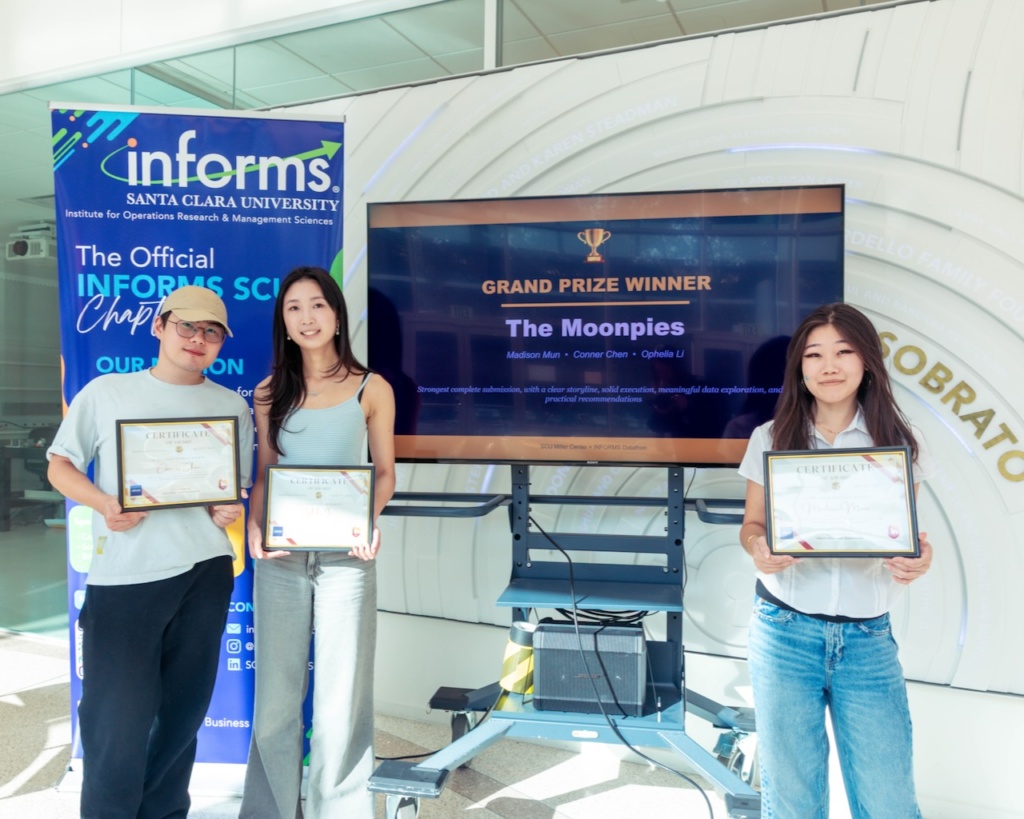
Congratulations to Team Moonpies — Ophelia Li, Madison Mun, and Conner Chen — who took first place with a project that judges recognized for combining rigorous analysis with a clear, compelling narrative. Their presentation helped translate mentor and entrepreneur feedback into practical recommendations for improving how the impact of mentorship is measured and understood.
The final presentations showed the participants’ critical thinking and judgment. Students had to decide which questions mattered most, how to clean and interpret imperfect data, and how to explain their insights in a way that could be useful to Miller Center. In doing so, they practiced the same skills that analysts use in professional settings: technical problem-solving, communication, judgment, and the ability to connect data to human outcomes.
Why This Matters for Mentors
For mentors, the findings reinforce something that is often felt but not always measured: showing up consistently, building trust, and giving advice entrepreneurs can actually act on helps them move forward. The data suggested that social entrepreneurs gained the most confidence in areas such as fundraising and having support, two areas where mentors can play a direct role in helping leaders navigate uncertainty and build momentum.
The Datathon also showed that better data can make mentorship easier to evaluate and improve. More specific feedback questions and stronger data collection practices could help Miller Center better understand which mentor behaviors are most effective, where entrepreneurs need the most support, and how mentorship contributes to long-term social enterprise growth.
Thank You to Our Partners and Supporters
This event would not have been possible without the support of Miller Center for Global Impact and the many people who helped plan, mentor, and judge the competition. A special thank you goes to Lynne Anderson for providing the data and to Linda Gentry from Miller Center for coordinating and supporting the planning process.
SCU INFORMS also thanks the graduate student mentors, judges, professors, professionals, and Miller Center representatives who gave their time to support the students throughout the Datathon. Their involvement made the Datathon accessible to students regardless of their technical backgrounds and provided participants with the support they needed to work through unfamiliar data.
Looking Ahead
The first undergraduate Datathon at Santa Clara University showed that student analysis can help make mentorship data more useful. It gave students the chance to interpret real feedback, identify patterns, and turn those findings into recommendations Miller Center can use.
SCU INFORMS looks forward to building on this partnership and exploring future opportunities for students to analyze data that can support Miller Center’s work. The next step is to keep refining the questions, improving the data collection, and using that information to better understand what makes mentorship effective.
__________
Photos:
Winning team: Team Moonpies
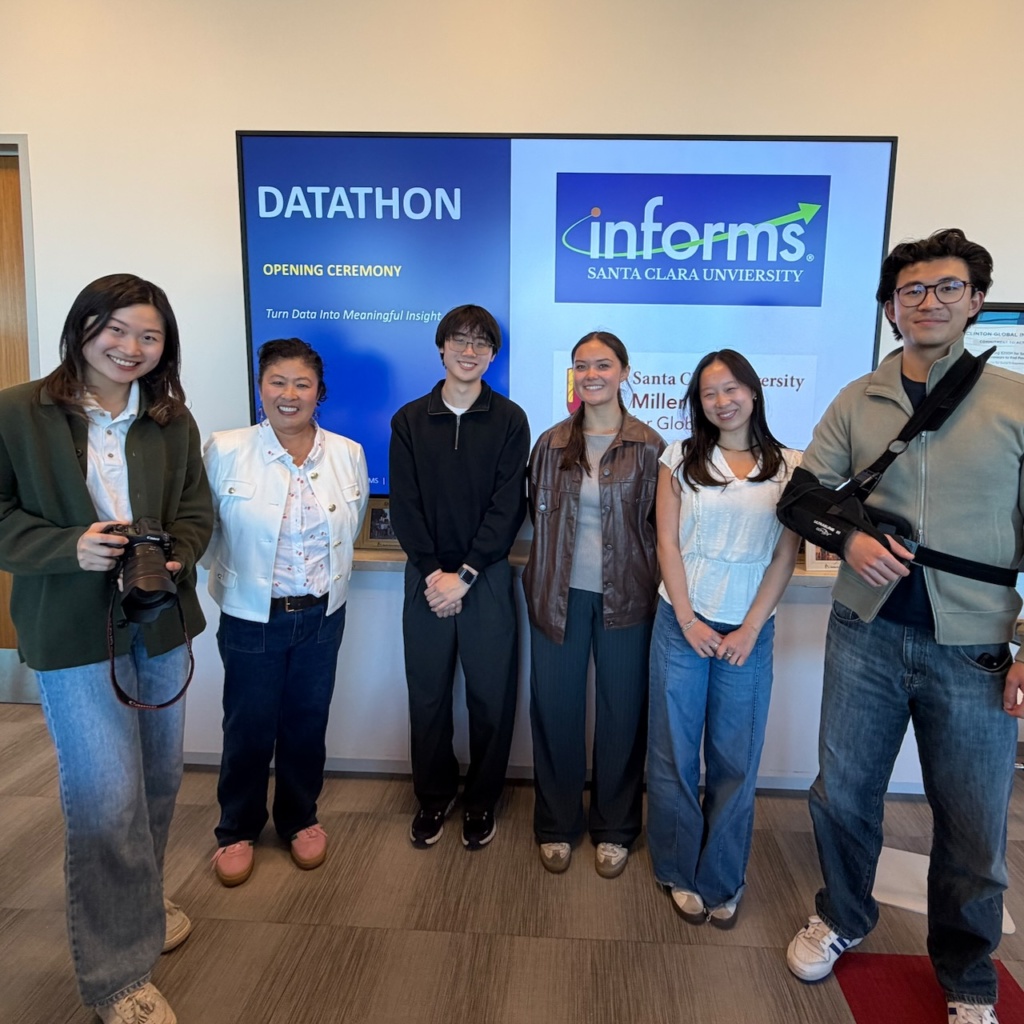
SCU INFORMS President Elaine Zhang (‘27), Miller Center’s Linda Gentry, Datathon organizers Cole Ang (‘27) and Ella Stewart (‘27), Member Outreach and Engagement Officer Nina Scott (‘27), and Leon Qin (‘27)
