
This is the fifth year Chevron is “Advancing Climate Resilience Solutions in the Asia Pacific Region” in partnership with Miller Center for Global Impact. We spoke with Mamata Borthakur, Head of Corporate Affairs for Chevron India, about the company’s approach to supporting communities where it operates and how the partnership with Miller Center is aligned with Chevron’s broader purpose of enabling human progress. We also heard from Miller Center Executive Mentor Connie Fogarty, who worked closely with Baeru Environmental Services, one of the 42 social enterprises included in the portfolio supported through the Miller Center–Chevron Climate Resilience Initiative.
Miller Center: From Chevron’s perspective, what has the Miller Center–Chevron Climate Resilience Initiative represented, and why was it important for Chevron to support this work?
Mamata: At Chevron, we believe our business thrives when our people and communities succeed. We strive to empower people around the world to improve their lives, achieve their ambitions, and, in doing so, meet their full potential. This is why it is so important that our community partnerships focus on the key themes that are relevant to the communities where we operate.
The Miller Center–Chevron Climate Resilience Initiative supports Asia-Pacific enterprises that have the potential to grow and scale their social and economic impact. These social enterprises are working to improve lives across multiple countries in Asia Pacific by delivering essential solutions for clean water, reliable energy, and climate-smart agriculture to some of the world’s most vulnerable communities.
Miller Center: What did Chevron hope to achieve when this partnership began, and in what ways do you feel those goals were realized over the course of the collaboration?
Mamata: Chevron aimed to improve livelihoods by helping social entrepreneurs improve their business acumen and accelerate their impact. Since the initiative’s launch, the program has supported a total of 42 social enterprises across Asia Pacific, of which 18 focus on clean energy, 16 address clean water challenges, and 27 are advancing smart agriculture solutions. Collectively, these enterprises have achieved $15 million in revenue growth and improved the lives of 6.2 million people in the region. The program also drove $91 million in investment growth across the portfolio and supported the creation of 2,600 new jobs.
NOTE: Data is collected through Miller Center’s annual survey for three years following the end of any programmatic engagement. Survey data is self-reported and measures longitudinal changes in key performance indicators.
Miller Center: Looking back, what outcomes or moments from the partnership stand out most to you, particularly in supporting women-led enterprises in India?
Mamata: In addition to scaling social enterprise impact, the Miller Center–Chevron Initiative commissioned research from Santa Clara University in 2022 to explore bias in how entrepreneurs, particularly women and minorities, access investment funding. The goal of the research was to help create concise and effective training programs for investors that have the potential to make a significant impact on the amount of funding invested in female-led ventures.
Regarding India, supporting social entrepreneurs in this region is vital because they deliver high-impact, locally grounded solutions while building pathways to economic inclusion. There are 29 social enterprises impacting India that participated in the program, and of those, 17 are women-led. By addressing systemic funding biases and equipping entrepreneurs with skills, mentorship, and investment readiness, the Miller Center–Chevron Initiative helps to unlock their potential to create sustainable, large-scale change across the country.
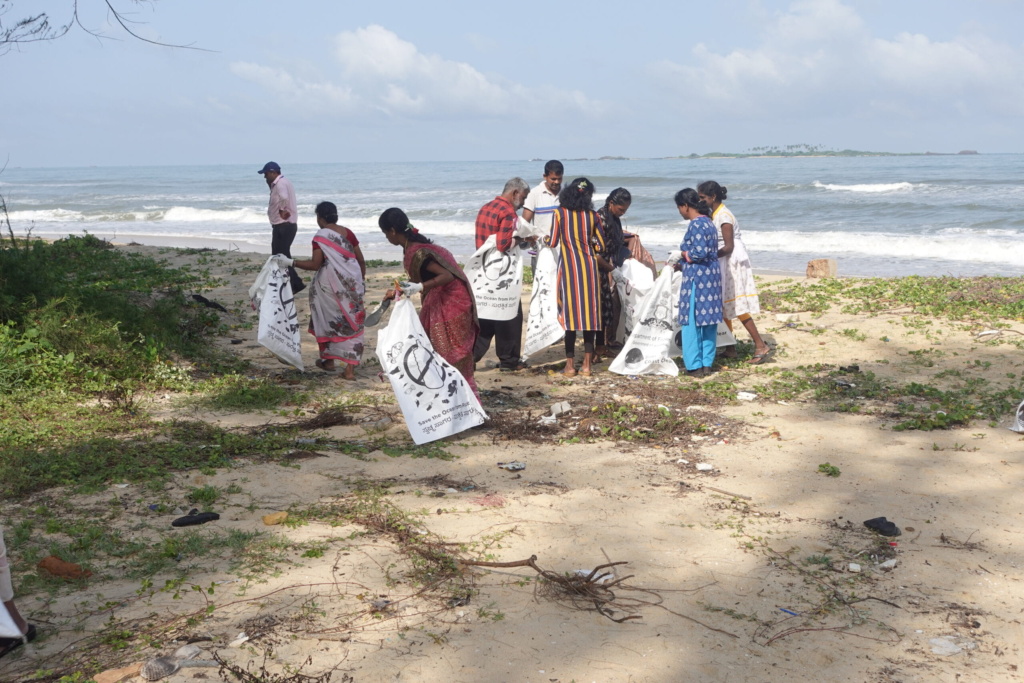
Miller Center: Yes, and one such example is Baeru Environmental Services, a social enterprise advancing sustainable waste management in coastal and rural communities across Karnataka, India. Founded in 2020, Baeru is led by Divya Hegde. Baeru, which means “roots” in the Kannada language, works to strengthen the resilience of coastal India in the face of climate change. Divya pursues this vision through a three-pronged approach that combines government partnerships, infrastructure development, and the creation of sustainable livelihoods for coastal communities, with a particular focus on empowering women.
As longtime Miller Center Mentor Connie Fogarty shared with us, “I was so impressed by Divya’s approach to the solution. She was able to build an organization that empowered disadvantaged women by giving them ownership and self-accountability, enabling stable livelihoods and financial security.” Connie, who specializes in strategic leadership, also highlighted Baeru’s success in tackling the difficult work of social change management. “Climate-focused social entrepreneurs face a lot of headwinds as they work to get things up and running and then to scale. Divya was able to create community-centered programs that inspire engagement and action for a cleaner ocean environment.”
Baeru recently completed Miller Center’s accelerator and is currently part of the Investment Readiness Bespoke Coaching program. To date, Baeru has created livelihood opportunities for more than 1,000 women, reached approximately 200,000 people across coastal India, and scaled to $1.83 million in annual revenue.
Miller Center: What do you hope its lasting impact will be for the entrepreneurs supported?
Mamata: Social entrepreneurship is a powerful tool for creating positive change. There are social entrepreneurs who are striving to make the world a better place, and we are incredibly proud to be working with many of them through this initiative. We hope that the support provided through mentorship, investment readiness, and strategic guidance will continue to help them scale solutions that address critical challenges.
___________
Photos:
Mamata Borthakur, Head of Corporate Affairs for Chevron India
Baeru Environmental Services