
A parcel delivery offer appears on a courier’s phone in Nairobi. The courier has about fifteen seconds to respond. If the offer goes unanswered, delivery platform Bolt Send can pass it to another rider. When a trip is completed, the courier earns a fare. Those fares help riders pay eWAKA for the electric vehicles and batteries they use for work.
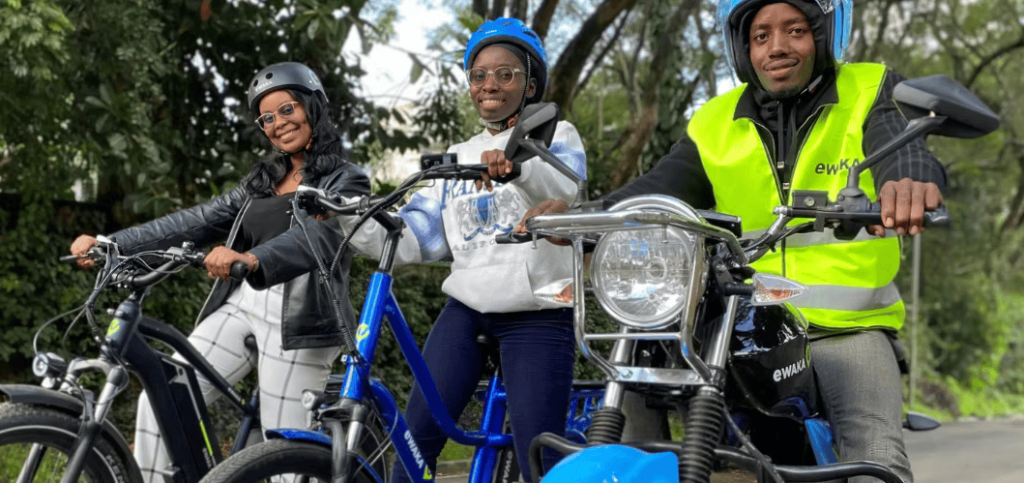
For eWAKA, the social enterprise that leases and finances electric bikes and motorbikes, those fifteen seconds are part of a bigger question. What helps couriers complete more deliveries and stay active? And as eWAKA grows, where should its team focus its support?
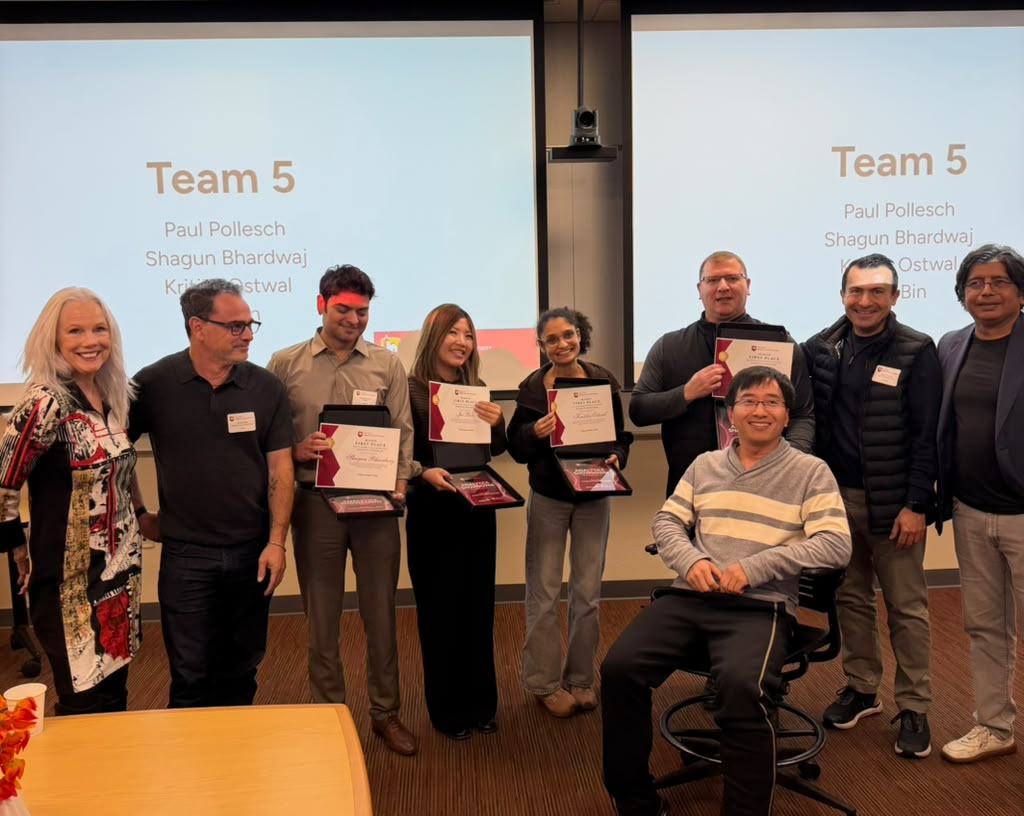
This fall, eWAKA brought those questions to Miller Center’s Data Analytics Showdown. More than 30 graduate students in the Master of Science in Business Analytics (MSBA) program at Santa Clara University’s Leavey School of Business tackled the challenge across 10 teams. The first-place team—Paul Pollesch, Shagun Bhardwaj, Kritika Ostwal, and Jie Bin—used eWAKA’s delivery records to identify when new riders might benefit from a check-in. In about ten days, the students turned data files with hundreds of thousands of delivery records into a set of decisions eWAKA could consider. One of their clearest recommendations was to call every new courier in weeks two and three and ask how things were going.
A New Question for Miller Center Social Enterprise
eWAKA operates in Kenya and Rwanda, and this project focused on its work with Bolt Send couriers in Nairobi. At the Showdown, Erin Keeley, one of eWAKA’s Miller Center mentors, walked us through what it takes to run that business. The founders have to source parts, assemble vehicles, recruit and train riders, keep bikes and batteries working, and navigate regulations. Each of those responsibilities makes a claim on the same small team’s time.
Through our Entrepreneur Network, Miller Center invites social entrepreneurs to bring a business question and data they’d like help analyzing. Miller Center works with Leavey to connect them with graduate students. Several teams receive the same challenge and dataset, so the enterprise gets to see what different groups notice and how they would act on it. This was the sixth Showdown, and since 2023, nearly 150 graduate students have participated.
eWAKA wanted to understand what was associated with courier performance, where more offers could become completed trips, and whether recent activity could help it anticipate what might happen next. The students could ask questions at office hours with eWAKA staff and Miller Center mentors. The Leavey organizer recalled that the shared Q&A document had the longest list of student questions they’d seen in six years. Once you look at the two files, it’s easy to see why.
Making Sense of Real-World Data
For the Leavey graduate students, eWAKA’s delivery records offered a lesson that’s hard to recreate in a classroom. Even a simple question, like how often riders accepted delivery offers, took some digging. The daily reports counted acceptance in two different ways, and a zero sometimes meant the number hadn’t been recorded. The students went back to the individual offers and rebuilt the measure before drawing conclusions.
A judge’s observation stayed with me. The winning team kept coming back to its mentors with questions and revising its approach as it learned more. Conversations with eWAKA helped the students understand how deliveries work in Nairobi and where the records told only part of the story. That back-and-forth was part of learning to advise a social enterprise. The students had to ask good questions, reconsider their assumptions, and decide how far the evidence could take them.
One finding gave eWAKA a place to start. In the small group the students studied, about half of new motorbike riders stopped appearing in the delivery offer records within five weeks. eWAKA told the students that some riders had left for better-paying work. What about the others? That question led the team to look more closely at how eWAKA could support riders in their first month.
What eWAKA Could Do Tomorrow
“We know what’s happening, but we don’t necessarily know why,” Paul, one of the winning students, said during the presentation. “And we want to find out why.”
The winning team proposed calling new couriers in weeks two and three, then checking how many were still active after 30 days. They also suggested reaching out when an established courier has an unusually slow week or a suspension, and using those conversations to learn how eWAKA could help. At the fleet level, the team recommended using a four-week average as a starting point for planning. They shared a browser-based prototype to show how eWAKA might review recent activity and decide whom to call.
The motorbike records gave the students only a few months of activity, so they treated an unusually slow week as a reason to check in. The immediate opportunity is to learn from the courier while the experience is fresh. As riders describe their obstacles, eWAKA could start recording those reasons and use them to decide what to investigate or change.
What the University Partnership Makes Possible
At the Showdown, Leavey Dean Ravi Bapna and the students shared an enthusiasm for what the project offered: a chance for graduate students to work directly with a social enterprise and apply what they’ve learned to a real business challenge. The students could put their graduate training to work on a question someone was already trying to answer. Through the Showdown, Leavey gave them a setting to practice the kind of judgment they’ll need when a client hands them a spreadsheet and asks what to do next. eWAKA gained a fresh look at its operations and a set of ideas its team can test.
For Miller Center, the Showdown is one way our relationship with social entrepreneurs continues after they complete our accelerator program. Being part of Santa Clara University means we can connect entrepreneurs with students and faculty through student fellowships, internships, capstones, research, and projects like this one. For others supporting social entrepreneurs, the Showdown offers a concrete example of what an accelerator and a business school can do together. The enterprise brings a live question and the expertise to put it in context. The university gives students the time and guidance to work through it. The accelerator brings those partners together and stays connected as the enterprise considers what to try.
Miller Center Executive Director Brigit Helms put the idea simply: “A good insight tonight can change a decision tomorrow.” For a rider in Nairobi who relies on deliveries to earn a living, a call in the second week could give eWAKA a chance to hear what’s getting in the way and help that rider stay on the road and keep earning.
__________
Photos:
Couriers using eWAKA electric vehicles
First-place Miller Center Data Analytics Showdown team