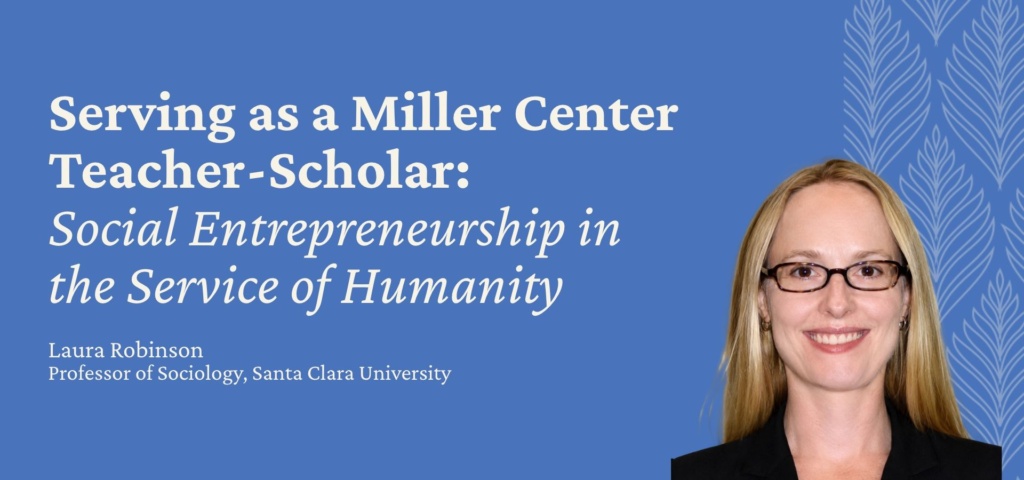
Social Entrepreneurship in the Service of Humanity
Among the many themes which have dominated the public stage in recent years, two are at the core of Santa Clara University’s Miller Center experience: the growth of community-driven social change and the vast promise of frugal technologies. Miller Center is at the forefront of the confluence of these two developments.
Given my work on innovation and inequalities, as well as research as a Brazilianist, I have had the great fortune to work with Miller Center on projects that have synergistically advanced both Miller Center’s mission and my own teaching, scholarship, and service, for which I am truly thankful. Since joining SCU in 2008, it has been my privilege to serve SCU’s Miller Center in a number of capacities that have deepened and enriched my career as a teacher-scholar in innumerable ways. In my first year at SCU, I was drawn to the mission and honored to begin service on the Center’s Steering Committee. Since that point, my teaching and scholarship have been indelibly stamped by almost twenty years of engagement with Miller Center.
Across the years, among many roles, I have served as a judge for the Technology Benefiting Humanity Tech Awards, as well as the Willem P. Roelandts and Maria Constantino-Roelandts Grant Program in Science and Technology for Social Benefit. I also was the faculty lead working with Dr. Keith Warner and Spencer Arnold to curate and assemble the Teaching Resource Library. In addition, Miller Center funded my work on digital inequality among economically disadvantaged youth in agricultural California. Thanks to the support, SCU students and I conducted micro-mentoring with hundreds of high school students, built college and career resources gifted to schools to serve high-poverty students who lacked home internet access, and provided detailed reports to our educational partners to enhance student school-to-work success. Finally, I had the honor of receiving one of Miller Center’s Global Impact Excellence Awards and serving as the inaugural Miller Center Lewis Family Fellowship Chair.
Regarding the latter, Miller Center pursues a multipronged strategy to find solutions to many of the world’s pressing problems impacting majority and traditionally underrepresented populations through its work with global social entrepreneurs through its Accelerator Program and Entrepreneur Network. A number of Miller Center’s social entrepreneurs provide extraordinary opportunities for our SCU students and faculty to serve their global communities through its Fellowship program. Indeed, among the most satisfying accomplishments in my career at SCU was to work with Miller Center student fellows to serve social entrepreneurs on a number of projects.
Listening First: Lessons from Solar Ear
The first team that I mentored was Solar Ear, based in São Paulo, Brazil. Solar Ear’s mission is to “lower hearing loss and its burden through the use of innovative appropriate technologies,” as they believe that “only through education can one break the cycle of poverty.” Solar Ear exemplifies the empowerment at the core of the Fellowship experience, championing community-based social change: “We use a bottom-up approach when we innovate. It was our workers who are deaf who invented the first rechargeable hearing aid, and the first solar charger.” They have been awarded The Tech Award, The World Technology Network Award, and Verizon Health Innovation Award. Both Miller Center and Solar Ear work from the premise that people can accomplish the extraordinary when given the right tools and opportunities to rise. As Solar Ear explains: “We train, hire and employ people with a disability as we know that people with a disability are people with a disability and not a disabled person. We look at the whole person and give them the opportunity through work to demonstrate their personal abilities” (see https://solarear.com.br/about-us/).

The Solar Ear Fellowship team, composed of Myles Sansone, Mary Catherine Duane, and Natalie Lays, traveled across Brazil visiting production facilities and clinics to conduct interviews with Solar Ear’s clients and community partners. Their goal was to “develop and analyze a new monitoring and evaluation tool (MET)” to measure the health benefit of Solar Ear hearing aids over time. While listening to Solar Ear users, they engaged in deep listening to prioritize the community’s voices. The team learned that community members weighed the social benefits of hearing aids as heavily as the health benefits. These included, but were not limited to, the power of hearing aids to provide individuals with agency to advance their education, accelerate their careers, and enrich their social lives. Uncovering the “social impact of frugal hearing aid technologies,” the team built a monitoring and evaluation tool for Solar Ear to track these benefits over time.
True to Miller Center’s experience, service is a journey with its own rewards. In serving others, team Solar Ear grew in ways they could never have anticipated. According to Myles Sansone: “The amount of self-reflection required during the Fellowship gave me the skills to understand and communicate with myself. These internal communication skills continue to positively impact my life today…The Fellowship asked challenging questions to help me dig deep into my thoughts and discover how to utilize my abilities and talents…I continually look back to the Fellowship to better my sense of self.” After graduating from SCU, Natalie Lays returned to Brazil on a Fulbright scholarship to work on community health initiatives at the Universidade Federal do Ceará before going on to medical school. In Lays’ words: “I know my work as a physician will be centered around social justice, working with underserved, vulnerable populations. This passion was something I discovered during the Fellowship. Personally, I will always be drawn to Brazil. It made a lasting impression on my heart.” The report “Tuning in to Solar Ear: Measuring the social benefit of applied social science for the public good” by Myles Sansone, Mary Catherine Duane, and Natalie Lays may be found on SCU’s Scholar Commons.
From Fellows to Changemakers
After working with Fellowship Team Solar Ear, I went on to mentor a number of other teams and Fellowship cohorts. Among them was the Solageo Fellowship Team of Zhuyu (Judith) Li and Riley Casey. The Solageo Fellowship Team worked in social entrepreneurship to deliver solar-powered filtration systems that provide safe water to underserved populations in East Africa and to develop franchise models to deliver safe water to rural communities in Rwanda. Judith Li was awarded the St. Claire Medal before beginning her PhD in Management & Organizations in the Questrom School of Business at Boston University.
I was also the faculty advisor for Fellowship Team Nurture Africa, with Grace Leete and Sydney Kaplan, for their project, “Nurture Africa Apprenticeship Retention Research,” which empowered vulnerable youth in Uganda through vocational training programs. In addition to being selected as a Fulbright Semi-Finalist for an English Teaching Assistant (ETA) in Uganda, Grace was active in a number of leadership roles for organizations including Santa Clara Valley Medical Center, Santa Clara Valley Health Hospital System, SCCAP Director, and Kidizens. Grace Leete was one of the recipients of the Richard J. Riordan Award for outstanding community service.
In addition, I mentored Fellowship Team Jibu, with members Lauren Kelley and Lia Kraaijvanger. The Fellowship team’s research sought to assist Jibu in earning Gold Standard Certification by measuring how the social enterprise’s processes translate into carbon credits by gathering data on its current and previous methods for obtaining clean water. Team Jibu’s report “Jibu Customer Carbon Savings in Rwanda” was recognized by the Krassowski Sociology Paper Award Program and published in the 2024 Silicon Valley Sociological Review. These Fellowship team reports, and those of many other talented Fellows, may be found on SCU’s Scholar Commons.
Why the Fellowship Sticks With You
For a more in-depth perspective on the Fellowship’s long-term value as a catalyst for awakening students’ understanding of themselves as changemakers, please see two co-authored publications with other members of Miller Center’s community. The first is “Digital Experiential Learning and Remote Research: Meeting the Ethics of the Moment with a Growth Mindset” by Laura Robinson, Katia Moles, Jennifer Merritt, & Keith Douglass Warner in the Handbook of Digital Social Science. We find that the Fellowship teaches students skill-building for resilience, the ability to build professional relationships through a variety of communication modalities, empowerment for self-confidence, and inculcating a growth mindset for future benefit.
The second publication is “Strengthening Ethical Commitments to the Common Good: Team-Based Learning in the Ignatian Pedagogical Paradigm” by Katia Moles, Laura Robinson, Jennifer Merritt, and Keith Douglass Warner. In this article, we examine the Fellowship as an exemplar of global participatory action research (PAR) and map out how Miller Center’s Fellowship program realizes the strengths of the Ignatian Pedagogy Paradigm (IPP): context, experience, reflection, action, and evaluation. We find that Miller Center’s unique emphasis on vocational discernment, paired with in-country teamwork with global social entrepreneurs and an intentional framework, is built to meet “the needs of young people in their search for meaning and purpose.”
As my experience has taught me, the Miller Center experience is exceptional at providing students with invaluable research opportunities with global social entrepreneurs at an early point in their careers—an experience that shapes their role as changemakers no matter what careers they embark upon. While the Fellowship prepares students to work in cross-disciplinary groups to solve pressing problems, even more important, it inculcates a spirit of service to unknown others coupled with vocational discernment. This powerful combination readies Fellows with a host of skills, preparing them for both post-graduation success and lives of deeper self-reflection—in sum, creating a fellowship experience like none other. As we look to the future, I have no doubt that from our home in Silicon Valley, SCU’s Miller Center will continue to lead the way in bringing the fruits of social entrepreneurship far and wide.
A Fellow’s Journey to Fulbright
Permission may be obtained from: Santa Clara Magazine Winter 2015
Natalie Lays ’14
A Fulbright fellowship to teach English at Universidade Federal do Ceará in Brazil
In summer 2013, a Global Social Benefit Fellowship from SCU took Natalie Lays to São Paulo for six weeks to work with a social enterprise that makes affordable hearing aids for low-income Brazilians. The Denver native is a veteran traveler—work, family, and interest in global culture and medicine have taken her to more than 20 countries. But it’s Brazil that’s drawn her back to teach English at Universidade Federal do Ceará and explore opportunities to engage in community health initiatives. At Santa Clara she studied psychology with an emphasis in psychobiology; practicing medicine globally is what’s called her since childhood. That’s been reinforced over the years—including by a trip to Guatemala just after she graduated from high school. She and two friends accompanied the father of their host family to a rural mining village to bring medicine to a young girl suffering from polio—a disease Lays thought was all but eradicated. “People getting sick just because of lack of access and knowledge gets me riled up,” she says.